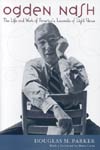
Foreword to Ogden Nash: The Life and Work of America’s Laureate of Light Verse, by Douglas M. Parker
My mother, a working-class woman of Mexican descent, never went beyond high school, but like millions of ordinary Americans half a century ago, she loved poetry. My mother especially liked reading it aloud or reciting it from memory. She knew a surprising number of famous poems by heart as well as a remarkable selection of obscurities. Her taste ran mostly to those anthology favorites that publishers and editors back then still credibly termed as “beloved.” Inspired by some turn of events, however trivial, in the day’s business, she would recite a passage or poem from Poe, Whittier, Longfellow, Kipling, Service, Byron, or Shakespeare. I loved her impromptu recitations, and I have often looked back on those occasions with both personal affection and a certain scholarly curiosity about how poetry once reached an enormous nonliterary audience.
There was only one living poet in my mother’s repertory—Ogden Nash. When she swatted some fly in the kitchen, she would intone with mock solemnity:
God in his wisdom made the fly
And then forgot to tell us why.
The appearance of either chocolate or alcohol would often elicit the remark that:
Candy
is dandy
But liquor
is quicker.
Did someone suggest danger? Mom would reply, “If called by a panther / don’t anther.” And no one could mention termites in our home without hearing the sad story of Cousin May, who “fell through the parlor floor today.” On those rare occasions when my mother, who worked nights at the phone company, read to her children at bedtime—what a special treat it seemed—she inevitably included “The Tale of Custard the Dragon.” I have often read this same ballad to my sons, enviously savoring its delicious wordplay. What poet would not covet the brilliant rhyme in which the cat Ink and mouse Blink flee the pirate?
Ink trickled down to the bottom of the household,
And little mouse Blink strategically mouseholed.
Nash was present elsewhere in my childhood, even if I didn’t always recognize his authorship. “Speak Low” and “Foolish Heart” were songs I heard innumerable times before I ever learned who wrote their urbanely romantic but irresistibly world-weary lyrics. The LP of Camille Saint-Saëns’s A Carnival of Animals at the public library had hilarious English texts by you-know-who. I even found an album of sheet music called Ogden Nash’s Musical Zoo by Vernon Duke among the piano music left behind by my dead uncle. I grew up knowing very little about contemporary literature, but even I, a West Coast Latin prole, understood that Nash was America’s unchallenged champion of comic verse.
I have often wondered how Nash’s work made its way into my childhood home. No copy of The New Yorker or respectable anthology of modern verse had ever entered our household. In fact, I don’t recall seeing any adult neighbor or relation, except my mother, ever read a book. One of the many virtues of Douglas Parker’s exemplary biography of Ogden Nash is that he so clearly documents and chronicles how this singular poet won a vast and appreciative readership during an era when American poets were universally declared to be unpopular.
Nash’s literary career was sui generis. What other American poet of the Modernist era published best-selling collections of verse, collaborated in Hollywood screenplays, authored Broadway lyrics, recited his work on radio variety shows, and served as a television game show panelist—all the while writing poems on contract for several of America’s biggest magazines? A few poets might qualify on one of these categories. Carl Sandburg and Langston Hughes wrote screenplays. Robert Frost appeared on television talk shows. And T. S. Eliot wrote—unintentionally—the lyrics for a posthumous hit musical. But no other American poet ever had a life quite so closely associated with popular entertainment and media celebrity. If Nash’s life was the exception to the rule of modern poetry’s marginality to American mass culture, it also demonstrates the many missed opportunities of poetry to find a meaningful place in contemporary society.
At the center of Nash’s unique literary life was a paradox. Although his commercial success and personal eagerness to please his large audience defied the general assumptions of a modern poet’s career, Nash was in his odd way a product of Modernism. He was an inveterate experimentalist—a congenial one, to be sure, but also a wildly inventive artist. In terms of technical experimentation, his work sits comfortably beside that of his critically acknowledged revolutionary contemporaries like Lorine Niedecker, Louis Zukofsky, Kenneth Rexroth, Laura Riding, and Kenneth Fearing. A comic poet eager to get a laugh, Nash was no alienated visionary, but however accessible his tone and subject matter, he was endlessly innovative in his versification and diction. Many of his poems are rhymed free verse. Some consist of ingeniously rhymed prose. His rhymes were not merely amusing but often revelatory—playing on the differences between speech and writing or brilliantly contrasting levels of diction, shades of etymology, or arbitrary features of English like the inconsistency of our language’s spelling and pronunciation:
I would live all my life in nonchalance
and insouciance
Were it not for making a living, which
is rather a nouciance.
Nash ultimately belongs to the neglected but important line of what I have called elsewhere Populist Modernists, those poets who adopted experimental techniques but rejected the uncompromising but elitist standards of High Modernism. These Populist Modernists include Vachel Lindsay, Carl Sandburg, Langston Hughes, Robinson Jeffers, Archibald MacLeish, and Robert Penn Warren. They constitute a lesser tradition than the High Modernism of T. S. Eliot, Wallace Stevens, Ezra Pound, and others, but their legacy remains a vital part of twentieth- century American poetry. Their poetry and Nash’s has never lacked readership, even though it has rarely received much support from academic critics or literary tastemakers.
Douglas Parker’s intelligent, informative, and engaging new biography fills a significant scholarly need in presenting the life and times of this neglected but important American poet. There is no comparable study not only of Nash’s life but also of the role that poetry, especially comic verse, played in modern American literary culture. But beyond its considerable scholarly importance, Parker’s book also movingly conveys the human story of an enormously gifted comic writer who often found himself at odds with his own era and yet found ingenious ways to match his talent to the times. It is a story long overdue in the telling.